Thursday, April 9, 2020

ESCAPE FROM NEW YORK: How Two of My Favorite Westerns Aren't Westerns Pt. 1/2


Prologue: The Legend of Kurt Russell 

Kurt Russel is kinda the man. I'm a big fan of his body of work. Very few actors embody to me the specific blend of swagger, cynicism, charm, and out-right action hero charisma that he can bring to just about any role. He's got range, depth to his characterizations, and can make you like pretty much any villain he plays (look no further than Guardians of the Galaxy Vol. 2 for that one), and can sometimes even make you kinda hate a hero he's playing (Lookin' at you, Sky High...). He's got it. That leading man star power. He's the man, man.

But he wasn't always. In the long ago and the far away he was pretty far from being the Man. In fact, if people knew him much at all it was as That Disney Movie Kid. In fact, according to legend "Kurt...Russel..." were the confusing and cryptic last words of Walt Disney himself. A compliment? A fever dream? A warning? We may never know. Not till we thaw out Walt's head anyway... But anyways, Kurt was making a pretty good living as an actor heading into the beginning of the 80s, even starred in a pretty well-regarded at the time tv biopic about Elvis Presley. But he was still known by basically any casting director out there as a wholesome child actor from things like The Computer Wore Tennis Shoes or The Strongest Man in the World, fluff-fare from the latter 70s output of the Walt Disney studios. And he wanted to change that.

As it turns out, there were two men out in the world that would help him do just that. One's name was John Carpenter. The other? S.D. Plissken.

...Just call him Snake.


I: BACK TO NEW YORK, or How Basically Every John Carpenter Flick is a Western

I've actually met John Carpenter. He's on the very short list of celebrities I've actually spoken to, also including Micheal Dorn and Marina Sirtis. But while that latter interaction went a little sideways, when I got to talk to John it was a really chill interaction and included some great advice. These were both at panels at conventions, by the way- it's not like we hung out. But yeah, he's a pretty cool guy. I was one of the last hopefuls who got to ask a question before the end of the panel when he, and I quote, had to head out "to meet up with my weed guy." Like a fuckin' legend.

I asked him how he chooses a project to focus all his effort into when a film can take so long to make and he obviously has such a wealth of weird ideas and projects. His advice? "Whichever one gets you the most excited, the one you can't stop thinking about." Which has definitely helped a scatterbrained creative like me, as it serves as a guide through my own mental wilderness. Which story should I work on? Well, which one's gettin' my dick hard right now? I have lots of ideas, but which one is taking up the biggest chunk of my attention, my enjoyable mental time? That's the one we work on. the others can wait. So thanks, John.

As you might gather from the other times I've mentioned Mr. Carpenter on this space, I admire both the man and his work very much. There's a leanness and intelligence in his films that are, to borrow a phrase, "all killer, no filler", especially apropos considering his breakout hit was of course the trend-setter of the Slasher Paradigm: Halloween. And one of the film-makers John has gone on record about admiring is Howard Hawks, who along with The Thing From Another World, also directed quite a few Westerns. As such, he's always talked about how a lot of his films are Westerns in structure, if not in genre or content.

And it's kind of a fun game to take some of the classic Carpenter films (especially ones that are original stories by Carpenter himself) and re-imagine their plots as Westerns, because you see the truth in his assessment almost immediately. Some still have a tinge of horror to them, but the premise tends to remain intact.


  • Assault on Precinct 13: A rundown, nearly abandoned outpost of Texas Rangers is under siege from a coalition of bandits and hostile tribes while holding several dangerous prisoners in their cells.
  • The Fog: A town founded on stolen gold is attacked one foggy night by the gang or descendants of the men they cheated out of the fortune to build their city.
  • They Live: A drifter stars to discover the town he's come to is being controlled by an affluent family who will do anything to keep their control of it's citizens hidden, or hell, maybe just make it a drifter who is facing off against an early incarnation of the KKK.
  • In the Mouth of Madness: A bounty hunter is sent to a lonely town to fetch a wayward writer of penny dreadfuls, only to find his quarry has formed a cult of brainwashed devotees to his "new bible" and will stop at nothing to either convert or destroy our hero.
  • The Thing as a Western is just The Hateful Eight. There, bam done!
Which of course brings us to today's outing: a disgraced former soldier must rescue a kidnapped politician from a fortified camp of bandidos in hostile territory, with time running out to avert war without his charge, and to escape a death sentence. Could be a pretty bad-ass Clint Eastwood movie, maybe something by Sergio Leone with Charles Bronson maybe? But no, in a nutshell, that's obviously Escape from New York.

Hell, it's even got Lee Van Cleef!
Now, that's where I come back to Kurt Russell and the other cool character I mentioned a few entries back, New York City! Because much like in my review of C.H.U.D.  NYC is back in major character mode as the setting that makes the story.

The year is 1997 (and may I say, I was in like 4th or 5th grade in '97 and I remember none of this...). After a spike in the American crime rate of 400%, and the outbreak of World War 3, the island of Manhattan is converted to the sole maximum security penitentiary for the whole country. A fifty foot retaining wall surrounds the island, the bridges out are fortified and mined, and the US Police Force surrounds it like an army, making sure once you're sent in, no one ever gets back out. Only problem is a terrorist cell devoted to the downfall of this dystopian police state has just hijacked and crashed Air Force One, with the President onboard (Donald Pleasance, playing the love child of Ronald Reagan and Margaret Thatcher *No, really- that was the head canon Donald Pleasance made up to explain why we had a US President with a slight British accent and while John decided not to include this fact in the film, in my world it's canon*).

"Mummy never said being President was going to be like this, eh wot?"
So, when it falls to Bob Hauk, the US  Chief of Police (Lee Van Cleef, exuding more raw masculinity while balding and wearing a little gold earring than the Dean of Ass at Stomp University) to get a search and rescue op together, he knows just the guy: former Spec-Ops soldier, and current foiled bank robber and incoming inmate, S.D. Plissken. But he prefers to be called Snake.

Pictured here, just being a MOOD.

Now, when John Carpenter set out to make this, there was a leading man he had in mind for this hard-bitten Western style gunslinger he wanted to drop into this scenario: He wanted Kurt Russell. How did he know about him? Well, remember that Elvis movie I mentioned? Well, that largely forgotten bit of television cinema was directed by Carpenter and marked the beginning of a collaboration and friendship between John and Kurt that would stretch from Elvis to this, to The Thing and Big Trouble in Little China (side-note: I didn't include that latter film in my conversion list because the script actually started out set in the Old West before it ended up being modernized by a rewrite!).

So to this film, may I say:
"Ah-thank yew ver-eh muuuuch..."
So once again, an ensemble cast forms, crazy shit is happening in the Big Apple, and I'm here to talk about it. So let's jump in the Gullfire and talk about it, yeah?

II: "HEY, I KNOW YOU... I THOUGHT YOU WERE DEAD.", or Why John Capenter's World-Building is A-Number One

So much about this movie just fucking works. You can regularly see the seams and spot the artifice of film-making if you're looking closely, but the strength of this flick is how well it's world is built. From set dressing (turning sections of actually burned out city in East St. Louis, IL into the seedy, dingy, rotten, and dangerous world of the prison island), performance and costume (Kurt as Snake was a revelation at the time, channeling Clint Eastwood out of awe of Lee Van Cleef, and showing up with an eye-patch that wasn't anywhere in the script on the first day of shooting, and wearing it with such confidence and assurance that Carpenter looked him up and down and said "...Cool.") to turning little asides in dialog into devices to make the world of the film feel much bigger despite the usual Carpenter trappings of claustrophobic settings and tight pacing driven along by his signature electronic score (which he composed himself more often than not).

"And how come you never show that kind 'eye-patch' initiative, huh?
 Like my earring. I worry about your future here, son..."

My personal favorite examples of this are the character of Cabbie (played by Ernest Borgnine, who some of you may recognize as the voice of Mermaid Man), who claims to have been driving the same cab for 30 years... so it stands to reason he was here BEFORE New York got turned into a prison and either couldn't get out when the island was cut off from the mainland, or was just a stubborn New Yorker who refused to leave. So now he is just dealing with how the neighborhood changing has made it harder to get fares and generally being the 'fun uncle' of this whole movie, being a comic relief character that isn't irritating as Hell ( no small feat).

And this scene, where he's so casually lighting off a Molotov cocktail
while chatting inanely and rescuing Snake never fails to make me laugh.
Again, world-building through subtle things, like how this just ISN'T weird for him.
And my other favorite being everything about the scene where Cabbie takes Snake to meet "Brain", (Harry Dean Stanton of Alien) a well-educated convict who has manged to use his knowledge of how to make gasoline (and his nest in the abandoned New York Public Library) to make himself indispensable to the lawless denizens of the city. See, when Snake finally meets him, he's got a familiar face. They pulled a job together a few years ago, but Brain (known back then as Harold) skipped out on him and left him high and dry.

And the kinda hilarious mention of "Fresno Bob" in this
scene always make me curious as to what other colorful characters lurk in Snake's backstory. 
So from there, the interplay becomes a mix of "I need your knowledge more than I want to kill you" and "How do I know you won't double-cross me again?" that makes all their interactions more fun. Plus, Brain has been 'given' a woman named Maggie by a grateful figure known as The Duke. Maggie is played by Adrienne Barbeau and her appearance in this movie is the whole reason that for years I just had a thing for Adrienne Barbeau and bad-ass women in cinema generally that I'm sure you've noticed by now...

Don't @ me, bro.
And of course, then there's the Duke. The Duke of New York, the Man, A-Number One, the most powerful gang leader in the entire prison colony, someone who has essentially carved himself a little kingdom of his own... and who got his hands on the President almost as soon as his escape module landed on the island.

He is also, in a turn that has always made me question how exactly this came about, played by none other than Isaac Fucking Hayes. Ya daaaaaaamn right...

Or, as you may have known him, the voice of Chef in South Park.
It's his only turn as an action movie villain that I'm aware of, and honestly? It's kind of amazing. Not only does the Duke have so much style that his personal car has chandeliers instead of headlights, not only does he have an entourage of psychopaths wild enough to make the biggest of ballers weep, but his actual screen presence as the Duke is enough to make you doubt NONE of this... his first proper introduction on screen, sauntering up to our captive hero all power and kingly authority then taking off his aviator shades (at night) to reveal a thousand yard stare and a distinctly un-medicated looking facial tic, is just one of those great moments that sticks with you after you've seen it.
 And then of course, there's the running gag anytime someone realizes who our monocular muscleman is: "Snake Plissken?...I thought you were dead..." And that ties in seamlessly to the device that Carpenter uses to propel this movie along at a pace that matches a careening taxi cab flying down a bridge full of mines: see, Hauk has placed two microscopic charges in Snakes neck, small enough to not impede function, but enough to open up both his major arteries and kill him in a few seconds, once a coating dissolves in 24 hours. During the last fifteen minutes or so they can be deactivated. But mean time? The irony of the running joke is one pointed out by Snake himself.

"I thought you were dead."
"I am..."

"Oooooh, NOW I get it..."
So the result is a tight, lean movie much like any other Carpenter piece. But because this one resides in a more fantastical world than Haddonfield, Illinois or the Antarctic wastes, the "futuristic" dystopia of New York in 1997 still feels really well developed through all these little touches, like there's a lot of stuff we're not seeing. It has a feeling of bigness on a budget a fraction the size of any film that could be compared to it in the modern landscape.

And speaking of that...

III: THE HOUSE THAT JOHN CARPENTER BUILT, or How to Make A Lot out of a Little.


Escape from New York was the biggest budget that John had ever worked with at this point in his career..six million dollars. Which is slightly less than a near-contemporary film a little low budget franchise starter called THE TERMINATOR. (Fun fact, there's a neat connection between these two films in that James Cameron worked in the effects department for Escape, helping create matte paintings for the panoramas of the ruined penal city. Just three years later he'd make that cyborg movie I mentioned with the beefy Austrian).

And while comparing the two doesn't seem fair, when one does? We see that John Carpenter has a skill that I think it's safe to say after films like Titanic (200 million that they're willing to admit to, but probably more) and Avatar (237 mil, estimated) that James Cameron doesn't. Jim needs millions upon millions to create immersive, distinct, and realistic worlds. To make Aliens and The Abyss took a combined 88.5 million dollars. Am I saying one director is better than other? No, I'm not.

What am I saying? Simple.

John needed six.

And delivered a spiked baseball bat post-apocalypse wrestling match that
a boy named Negan probably masturbated to with one hand while taking notes with the other.
I have talked before about fearless artists, like Richard Stanley or Nic Cage. And I think it takes a special brand of fearless to look at a (small to some, but) bigger budget than you've ever seen, wipe the dollar signs out of your eyes and the drool off your chin, and say "Ok, let's do it. I'm not wasting a cent of that shit." and then proceed to do just that. John was never scared when he made a movie cuz he's SMART, the kind of smarts you get making every piece work perfectly, making lean mean fighting machine movies.

By being all killer and no filler.

And in all of the films where John Carpenter has shined the brightest and his contributions have echoed the longest in cinematic canon, one thing has always seemed to be true: People stepped back and let him do his fucking job. Leave John Carpenter alone with some time, his weed guy, and six million dollars, he'll deliver you a timeless action classic.

Makes me wonder what he could have done with a project that was Cameron-level big, if people had the guts to try it instead of largely ignoring his work and doing so little to foster his career at certain points. And it pisses me off he's never gotten to make an actual  Western. How much greater could my favorite actual Western Tombstone have been if it had been handed to John Carpenter?

We'll never know, but if I ever meet him again, that's gonna be the question I ask him.

Watch Escape from New York on Amazon Prime, ya filthy animals.

And keep your good eye on this space for part 2 of this series, after our big project next week...

NEXT TIME: THE APOCALYPSE BEGINS....THREE TIMES.


Wednesday, April 8, 2020

Meet the "PARENTS": A Hallucinogenic Head-Trip into Cannibalism and Conformity


I'm really pleased to be talking about this one today, for a few reasons.

  1. Unlike some of my other subjects this film doesn't even have much of a cult following. In fact, in comparison to even a film like C.H.U.D. which had 50some pictures for me to scavenge off IMDb, and some factoids to raid for fun supplemental content, Parents has only 13 pics, three or four trivia factoids, and just three quotes. Not a lot of folks are obsessing over this flick and they honestly have missed a trick.
  2. The "Suburbia is Hell" sub-genre of horror is a really fun one that doesn't get enough love, and I was reminded of this movie with another entry coming soon to...somewhere, probably not theaters... the eerie-looking Vivarium with Jesse Eisenberg and Imogen Poots (fun saide-fact, I once had an entire conversation with someone about how they thought her name sounds made up and ridiculous, and my response was to quote Infinity War a few years early with "But all names are made up...")
  3. Most of the "Suburbia is Hell" set, like the Joe Dante classic The 'Burbs, The Stepford Wives, or the "Lassie-but-with-zombies" farce Fido, augment their premise by also injecting a fair amount of comedy and satire, and Parents isn't too different on that score except that it's jokes all land in the same discomfiting way: like someone who makes a really offensive, misogynist,  racist, or otherwise "edgy" joke and say they're just kidding... but something going on behind their eyes makes you suspect they aren't joking... they might just mean it. The humor of Parents isn't funny. It's dark comedy the same jet-black shade as very old dried blood. It's predatory, and that dissonance makes the suspense that underlays it all palpable.  


I: HEY THERE SPORT...


But first- We MAMBO!


I want to talk about Perez Prado for a second. Then we'll get back to the movie. Perez Prado was a Cuban born band-leader who became famous in the 1940's as "The King of the Mambo". He and his orchestra topped charts in the UK and the US with hits like "Mambo No.5" and "Cherry Pink and Apple Blossom White". He is largely credited as bringing Latin music to a forefront of popularity in America during this time period, his sound becoming synonymous with the period and evocative of that other 50's cultural juggernaut "I Love Lucy", paving the way for success of other artists in this field like (of course) Desi Arnaz and similar artists with that big Caribbean style like Harry Belafonte (and if you don't know who that is, but have seen Beetlejuice? one word: DAAY-O!) And because this music was initially popular in the 40s, by the time the young folks who loved it then became the progenitors of the Baby Boom, this was the music the parents of the Boomers listened to. So it's what our main characters listen to, and big band stuff like his is what fills in for a proper score most of the time, incidental music mostly being ominous hushed tones to amplify suspense.

Anyway, Prado led his orchestra for decades, all the way up to his death in 1989...the same year this movie came out. Do I think Parents killed Perez Prado? No. But it does begin with a strangely disharmonious rendition of his signature hit "Cherry Pink and Apple Blossom White" while a mint-condition Oldsmobile prowls it's way through the suburbs of 1950-whenever carrying our three chief characters this narrative revolves around: Mom (Mary Beth Hurt), Dad (Randy "Shitter was full! MERRY CHRISTMAS!" Quaid), and little Micheal Laemle (Brian Madorsky). And the strange irony of a child being raised by serial killers being introduced by the music of a man who died around the same time the film was made was something that struck me as interesting while prepping this dissection.

And make no mistake, while the film itself plays coy for a little while as to what the titular parental units are about, the official synopsis and any discussion of this flick DOES NOT, so the fun becomes just watching this weirdness unfold knowing it, and watching Micheal be consumed in a more metaphorical fashion by the creeping certainty that these two are up to something...

Because these two...they're something else. We meet them more directly while they are talking at the dinner table while Micheal plays in the foreground. I say plays, but it's not like the kid is having fun. In fact, one of the hallmarks of this kid's performance is how perfectly he captures the dead-eyed hollow look of a victim of ongoing trauma.

This framed  picture shows up in Mom and Dads bedroom at one point,
and captures the emotional landscape of little Mikey perfectly.

While Micheal 'plays', his parents 'chat'. But the chat quickly becomes a nuzzling bit of barely restrained snogging, which, when noticed they're being watched just gets a cheerful "Bed time!" from our dear old Dad.
Looks like somebody is tired of having an only child...

This leads to a conversation between Micheal and Dad about his son's fear of the dark and his troubling streak of nightmares. Dad seems all gentle paternal authority in demeanor, but in actual content his advice is deeply unsettling, warning the darkest place you can't get away from is...then points at his head.

The More You Know...
the more likely Randy Quaid will have to eat you.
And this sets up the unspoken dynamic between Dad and Son through the rest of the movie:
 "Be more like me, Son"
"But you fuckin' terrify me, Dad"

After that we get a deep dive into his nightmares, literally, as the transition from waking to dream is done with a brilliant visual trick. As Micheal takes off his pajama top, revealing an emaciated frame that makes him look more like a little old man than a 10 year old (because you see, on top of everything else, he never eats his meat! How's he s'posed to get any pudding if he won't eat his meat?), he performs a maneuver anyone who's ever been a scared little kid (so, y'know all of you) is familiar with: the running leap into bed to avoid the monsters. But as soon as he hits the sheets, the sheet collapses under him and he plummets into a bottomless pool of candy-apple red blood. It's a great introduction to the hypnotic and surreal nightmare sequences that occur almost at random throughout the narrative. One of the elements about the nightmare subplot I really enjoyed is that because they start and stop so unpredictably, we as the audience begin to question what is real and what is the fevered imagination of Micheal Laemle and that means we're taken off guard the moment we realize that something horrible happening midway through the film ISN'T a dream.

Sidenote: My mom has the same cookbook as the Mom
in this movie and spotting it made my stomach physically
lurch when I first saw this flick. 
And the specter of something horrible happening hangs over every second of this movie. The main reason for this? The performances of our parents.

II: HOW'S IT GOIN', SLUGGER?

The acting in this movie is off the charts creepy. I feel like the director gave a very simple instruction: "Pretend everything is fine, but that you're always about 5 seconds from hurting this kid."
Quaid's performance is all watchful glares, slow smiles, and unsettling advice. He's the picture of 50's suburban conformity, every part of his and his wife's image tailored to be stylish, up to the minute, and above all: invisible. He even waxes poetic on this during a scene when he spots his little boy watching him warily and decides to make it a teachable moment. While fryin' up a kidney, he goes on about how conforming, being how people expect you to be, and keeping watchful of others is "the next best thing to being invisible". Which is of course how the Laemles thrive and survive.

(Side note I didn't know where else to put, the name Laemle is a reference to former Universal head honcho Carl Laemle, who helmed the studio through the first great horror boom of cinema, the age of Dracula, Frankenstein, The Mummy, and my personal favorites Bride of Frankenstein and The Wolf Man.)

Mom is just as subtly unnerving, constantly trying to get her son to eat more, but always with a focus on meat. But she's never clear what kind...One of the signature moments of the film is a discussion of what they're having, to which his parents simply reply, "Left-overs." What were they before they were left-overs? A knowing glance to one another precedes one of Quaid's slow smiles, then: "Left-overs-to-be..." Mary Beth Hurt brings a strange mixture of the same barely restrained violence as her husband, but she obviously favors her son more than Dad does, having more honest moments of care and compassion with him, however fleeting. But the most upsetting parts of her perfect home-maker performance is her smile and her laughter. The real Mom is a quiet, wary soul much like her son, and her life revolves almost entirely around cooking up different cuts of prime people. But when entertaining or socializing with other adults, her laughs are a little too loud, her smile never quite touches her eyes... and in that subtlety she actually outshines Quaid by quite a bit in my estimation.

Several times Randy's more authoritarian delivery of certain lines and the over-all coldness of his body language, plus his slicked, immobile hair style, put me in mind of Lt. Cmdr. Data himself, Brent Spiner. And personally I would have loved to see the man that brought such sneering villainy to Lore take a crack at this part and see him flex himself so far outside of the main role he is known for.

I haven't really talked much about child actors on this blog, and Brian Madorsky is mostly known for just this film. He's not a bad child actor, as I noted before he plays the trauma of his life very well. You can count on one hand how many times in the narrative he smiles. But in the scheme of it overall, we don't know  much about him. He's a cypher, mainly meant to be our pint-size vantage point onto the suspenseful interplay of his parents and the rest of the world. But this is where the direction shines, placing Micheal low in frames, showing us his lens into the world, the way he filters information with a child's characteristic lack of understanding of sex, violence, adult customs, and...life, really. He's so insulated from normal that some of the moments where he does shine are when he interacts with normal people and they are struck by what a morbid mind he seems to have.
During his first day at school he tells the teacher (and his entire class) when asked to tell them "something new" about an old folk ritual that involves skinning a cat, boiling off the bones, then sucking out the marrow to become invisible. The teacher of course recoils at this, but keeps her cool. This does however set off the two other major threads of the supporting cast: Millie Dew, and Sophie Zellner played with puckish charm by Juno Mills (she's from the moon).

This kid's eyes do more work than some whole actors do in their entire career.
Sophie is a fellow new kid, with problems of her own. Her father works with Micheal's father at the chemical company TOXICO (a rather on-the-nose bit of symbolism for pretty much every relationship in this movie) making industrial grade defoliants. That Dad's distaste overall for plant matter even extends to his job makes me smile a little, nothing like keeping to an aesthetic, huh Randy?

Anyway, she thinks his story about dead cats was neat. See, Sophie's got some behavioral issues that resulted in her being held back a year. This also has the result of her being a whole foot taller than her new friend Micheal, but there's a nice bit of blocking in their first interaction: as they walk out of school, and she begins spinning a yarn about how she moved here from the Moon, not Vermont, Micheal is staring up at her not sure if he should be incredulous or bemused. As they continue to talk, and they decide they like each other, Micheal is walking up an inclined concrete retaining wall next to them. Once they're firmly established as friends, they're around equal heights. It really highlights how the blocking and shot composition of this movie works really well to establish something that might not be immediately obvious from the strange, obtuse dialog real children often have.

Looking around online, I couldn't find a screencap of that shot,
 or really any pictures of Sophie and Micheal beyond this one so it'll have to do.
There are scenes where Sophie reveals she understands a bit more about the adult world than Micheal does, but she mostly uses this knowledge for mischief. And this is mostly because her parents are boozy and neglectful (despite their similarly strait-laced appearance to Mom and Dad Laemle), almost never appearing in the same scene together and only sharing one line of dialog with their daughter. When Micheal compliments her on that her Mom is really nice, Sophie scoffs saying that she always treats other kids nice, but not her. Micheal just sulks in response. At least her mom doesn't eat people, right bud?

"Seriously, the Thompsons AGAIN?"

And then there's Millie Dew, a social worker called by Micheal's teacher after one too many moments of morbid behavior from her new student start setting off alarm bells. Millie (Sandy Howard)  is one of the best portrayals in an already solid cast, doing a lot with a little and really selling her character as a first-wave feminist liberated and educated woman, through the way she chain-smokes in a public school, dresses in a manner I can only describe as 'eccentrically frumpy', and acts clumsy to put people off guard, then follows up with incisive questions. A scene she shares with Mom really draws in on the eventual face-off these two will experience later, with Ms. Dew trying to pin her down. My favorite line from Mom comes in this scene, when asked to describe her son: "Well, he's not much of an eater..." Once again, everything in her life revolves around her hellish version of the domestic, and it's another one of those funny-but-not-really moments.

Millie Dew, pictured realizing she might have just fucked up later on in the movie.


III: KIDS! WHO MADE THE LITTLE BASTARDS?!

So one of the reason I think this flick works so well based mostly on performances is the director himself, Bob Balaban. When I looked him up I had a moment of "Oh, THAT guy!" That's right, he's mostly an actor, with a majority of his directorial work being in television.(including an episode of "Tales from the Darkside", the similarly suburban horror comedy My Boyfriend's Back, and few episodes of the surreal suburban supernatural show "Eerie, Indiana", so honestly I think maybe he was working through some stuff concerning this subject matter for a while...) I also think that this is one of those cases where the director is an actor as well and thus really knows how to tease just the right performances out of his cast. Not to say his chops as a technical director aren't spectacular too, I've already complimented his blocking and how it enhances the story. But his master-stroke is a memorable scene with Ms. Dew in the Laemle house where she stumbles onto something shocking and her scream literally travels through the house, down vents, hallways, and finally up the chimney, all in one solid shot.

He also perfectly captures lots of the little, timeless things about being a kid in any era. Making friends, the giddy joy of doing something you're not allowed to, and the esoteric thrill of overhearing adults having conversations you shouldn't be listening to and don't really understand- but feel like secret messages from another universe itching to be deciphered.

"Seriously, how do you even have a party with keys?"

And that creeping sense of menace I mentioned just keeps building as it becomes clearer and clearer to Micheal that his parents are into some pretty sick shit and they won't rest until he's onboard too. Quaid really ratchets up the subtle crazy, being the man of the house becoming more stressful for him as he realizes he's not getting through to his kid.
 A scene of him disciplining Micheal gets a little too real, when his wife chides him that "This isn't the way. You're scaring him."
"Yeah? Well, Mister you scare me too. You don't look like me. You don't act like me..." 

Being a kid who experienced a lot of tension due to how different I and my own father were, that scene genuinely rattles me. Eventually, the only time Dad seems happy is when he's out at the grill, warming up some more leftovers...

Nothing to see here, just a man and his meat...


And of course as we discover more about how Dad operates, quietly doing his job and then sneaking down to where his company keeps medical cadavers for research, sometimes even delegating to unwitting assistants to save him some prime cuts, Micheal can't deny the truth any longer and we creep in on the moment of truth, executed in a fabulously disorienting sequence of the family at the table while the house slowly spins around them and the Laemles face the facts of life.

I also love the inversion of the "Now eat your vegetables," parental edicts in a family of cannibals.
And this little dude's face just screams "Okay, Boomer..." despite the fact he, y'know...IS one, technically.

The disdain the Dad has for his son, while his Mom holds out hope he'll come around ("Your son. The vegetarian..." he snarls, making it the worst possible slur he can) is the driving force behind the way the climax boils over in the last act of the movie. Eventually all the other satellite characters that have populated the second act simply drop away and the story returns to the nucleus of it's foundation: the nuclear family experiencing a macabre meltdown over the son's refusal to conform both outside and inside the home.

The story literally trims the fat for it's third act...
The only thing the movie loses as it adds on this momentum is the great, distinctive surrealism of it's nightmare scenes and the slow unpeeling of the layers of weirdness of the family are not as provocative once they're laid bare. Maybe three seasons of "Hannibal" and the overall works of Thomas Harris have left me a little jaded to just boring old vanilla cannibalism? But the climax feels a little rushed and not as cathartic as you'd hope, especially once it becomes clear our little hero has merely leapt from one frying pan into another fire.

But it still remains an overall big recommendation if you want to have a good time with a simple concept that is presented with style and a timeless flair for the heart of being a kid: everything is scary, nothing makes sense, and you're a little afraid of the day it will...

It's on Amazon Prime, just like yesterday's (and tomorrow's) selection!

So I'll leave you with my favorite of the surreal WTF moments of Parents, and if that doesn't convince you, nothing will:


If your first thought is "I've seen enough hentai to know where this is going..." then congratulations- you're one of my people. Poor bastards...


NEXT TIME: CALL ME SNAKE...

Tuesday, April 7, 2020

C.H.U.D.: A Surprisingly Relevant B-Movie in 2020


I: On The Town, or "Oh Homer, of course you'll have a bad impression of New York if you only focus on the pimps and the CHUDs.."

So, no joke- I love New York.

Or as the poets call her...New Yaawk...


Not like, as an actual place though. I've never been there. I certainly  have no intention of going there just now.

I have no deep personal ties to it, historically or geographically. To the best of my knowledge my family didn't come here through Ellis Island or something, generations back.

No, I love New York as a character. See, so many of my favorite movies take place there that despite having never been there, I have this sort of familiarity with it as a fictional setting and character in and of itself.

King Kong, Teenage Mutant Ninja Turtles, The Avengers, Spider-Man, Escape from New York, Superman (Metropolis in the Christopher Reeve movies is just NYC wearing a different name-tag), The Beast from Twenty Thousand Fathoms, Vampire in Brooklyn,  the list of films I love that take place in New York literally goes on and on and on. And New York features in all of them not just as a setting, but occasionally as a character in and of itself. Traits about New York are what make certain narratives unique and special. Would King Kong  have been as memorable if the big ape had climbed up some random building in another port city? A particularly high building in Boston?

Would The Avengers  have looked as cool defending Kansas City from Loki and the Chitauri?  Could it have been as exciting and unique a journey if The Warriors had been trying to get across Orlando to get to Disney World or something?

Hell no. The Warriors have to get to Coney Island, can you dig it? Kong and the Empire State Building are synonymous in my mind. And hell, because Stan Lee was such a dyed-in-the-wool New Yorker, the majority of the Marvel Comics universe sprung up whole cloth from the streets of the City That Never Sleeps.

Yeah, New York is quite the character in cinematic canon. But there's only a few movies where one could argue that NYC is the main character.  And my favorite of this much smaller club...is a little movie called C.H.U.D....


Accept no substitutes.

II: The Social Horror Story, and the "New York Feel"

C.H.U.D. begins in a very similar vein to a spiritual cousin Jaws: with a minor character minding their own business, just to get killed in a creepy manner by a largely unseen menace.

The difference between the two is that the shark attack that opens Jaws  builds up slowly and steadily. Not so in our little feature under discussion today. Nope, a woman walking her dog gets killed by a CHUD in a little under 45 seconds,  pulled down into a man-hole by a slimy clawed hand in blink- leaving nothing but a discarded white pump and the awesome title shot I included above that kicks off this experience.

C.H.U.D. is surprisingly complex for a movie with a premise as B-movie as it is: toxic waste under New York is mutating homeless people into flesh-hungry mutants, the Cannibalistic Humanoid Underground Dwellers, or CHUDs for short. That's it, that's the story in a nutshell.

"We're here. We're gonna eat your face. Deal with it."
But the way it's pulled off is on a really unique and engaging way. Presenting us with an ensemble cast that slowly comes together over the full cut's 96 minutes (there were several snipped and extended cuts for television that floated around for a while before the full film regenerated itself on a later home video release), it presents this B-premise in a smart A-script way that reminds me of the character-driven nature and improvisational feeling of the (also very NYC-centric) horror films of Larry Cohen. Many of the characters are allowed to sort of just be themselves while onscreen in a very unrehearsed and natural feeling way.

It presents the plot through a more socially driven brand of "What If...?": What if an apex predator moved into the urban jungle of New York, and it's preferred prey was human?

The answer to this question is presented through the reaction of New York as an entity to this nightmare scenario at every level of it's society, thus making it into that beast even more rare than a CHUD: the Social Horror story.

  • At the lowest level are the CHUDs themselves, a mole-race of entrancingly disgusting mutants that feed on flesh, prowling the shadows of the film, but rarely being seen directly. Many of the scenes with these guys they're kept out of sight, or seen as only clawed, misshapen hands that are moving aside manhole covers or snatching up their unwary victims. In my opinion, this is another piece of DNA this flick shares with that obscure little shark movie I mentioned earlier, and much like with Bruce the shark, the CHUDs being kept largely out of sight works to the films advantage. A guy in makeup and a mask is only so scary. Something lurking in the dark, around the corner, just outside the door, or under your feet... much more effective.


But when they do show up, they're awesome. Seriously, there's no snarky joke here.
I just straight up love their simple but grotesque design and those
glowing yellow eyes haunted my dreams...


  • Because the threat emerges from the underground of New York, the first to be affected are the Undergrounders, also sometimes referred to as the "Mole People", the city's subterranean homeless population. They're represented by Mrs. Monroe (a humble bag lady we meet after she's arrested for trying to steal the sidearm of a beat cop), her brother Victor, his best bud Hugo ( a piece of I think deliberate symbolism, as Victor Hugo wrote politically-oriented ensemble stories like Les Miserables and The Hunchback of Notre Dame), a knife-wielding schizophrenic named Val, and the Reverend A.J. Sheppard, an ex-con who runs a soup kitchen out of a crumbling row-house (played with a manic hippy zeal by Daniel Stern of Home Alone Wet Bandits fame) and is noticing the diminishing numbers of his 'regulars' to an extent he's called the cops about it.
  • Next to become aware of the problem is Captain Bosch of the NYPD, who's been trying to clear the case load of the rash of missing persons in his precinct, but getting very little help from higher up, to the point a Captain starts doing a detective's work to figure out what's happening. We find out later the woman in the opening is (was) his wife Flora, in a pretty emotional scene between him and Sheppard. (also Christopher Curry, who plays him, was in Home Alone 3 it turns out. Huh.) He's also having to dodge the badgering of Murphy, a freelance reporter who smells something rotten in the Big Apple with these missing persons too.
  • Next up the ladder, some Young Urban Professionals: Cooper, a photographer (and friend of Mrs. Monroe) who recently won some awards with a piece on the Undergrounder homeless population and thus is privy to their plight moreso than most on his social level would be (played with a disaffected cynical sarcasm by John Heard of Home Alo-... Wait, WTF?), and his girlfriend Lauren, a model. They just moved into a new apartment complex... one with a tunnel access in the shared basement storage area...(more on that later) Along with them are various other tenants in the building, and other regular New Yorkers, some of whom simply notice that something is definitely wrong around them, some of them just get devoured.
  • And from there we encounter several higher up entities of the political machine of NYC such as the Chief of Police played by Eddie Jones (best known to me as Jon Kent from the Lois and Clark tv series and TO THE BEST OF MY KNOWLEDGE not in any fucking Home Alone movies...), and a representative of the Nuclear Regulatory Commission called Wilson and his assorted cronies, the source of the all the trouble Bosch is having pursuing these disappearances since, like a conspiracy theorists wet dream, they're engaged in a massive cover-up about both the murderous monsters being spawned beneath Manhattan...and the real meaning  of the the movie's titular acronym...


Presented here as a handy diagram of the new food chain in New York.

 And of course, above them all, NYC itself, being a strange, anarchic presence all it's own and giving C.H.U.D. the undeniable "New York feeling" that makes it so unique. This movie is not afraid of how dirty it's subject matter is or how anarchic and strange just a walk down the street in New York can be.


For instance, this shot: Bosch, doing hero shit, solving mysteries.
Homeless guy, playing drums on this mailbox for the whole scene,
and nothing else, in the background without comment.
Shine on, you crazy diamond.
The Undergrounder characters are not glamorously homeless; they're filthy, desperate, and scared, played with the manic, prey-animal intensity of people who are now being literally victimized, after a lifetime of it metaphorically. Sheppard looks like he was born dingy, his patchy beard, dirty neck and sweat-stains showing him as a real person, not a polished picture of humanity. Bosch and Murphy look like average joes, and even on up the chain, very few people are presented as movie-star good-looking (aside from the obvious exception of Lauren the model, but even she is presented in a grounded way, usually dressed in ordinary clothes, and with a level-headedness that serves her well later) and are generally very just...real-looking. And all that grounds New York as a place where not just anything can happen, but THIS crazy shit can happen  too. Which does so much to temper the patent ridiculousness of the movie as presented on paper in black and white.

And speaking of white- My one criticism here is one that is indicative of the time it was made: much like tv shows like Mad About You or Friends set in New York (one of the most culturally diverse single cities on the planet)... it's a bit lacking in representation, and is something that a good remake could remedy really well, I think. It really struck me on my latest viewing that it is an extra level of (likely unintended) social commentary that this only becomes a problem for New York at large when the Chuds start running low on the homeless and come up to eat random white people.

So why do I think a modern remake of C.H.U.D. could be really interesting?

Other than wanting to see this cute widdle pun-um on the big screen?


III: Influences, Influencers, and Influenza

As I mentioned before, there are a few hints here and there that the screenwriter may have wanted to find out what it would look like if Victor Hugo wrote a shitty monster movie. A city on the edge, desperate people from all walks of life, a tragically heroic cop, and the dregs of society banding together against a corrupt government. And flesh-eating mutants.

As such, the script for C.H.U.D. is a lot more progressive and socially conscious than you'd think from my earlier criticism about it being Terribly White.

In fact some of the things that really stood out to me on my most recent viewing was the palpable tension between cops and the public, the overall opinion of governmental authority in a crisis (I'm coming back to this in a minute, by the way), along with a frank and honestly (for 1984?) unheard of discussion of abortion, a woman's bodily autonomy, and how it's a woman's choice and nobody else's what she does with her own body when Lauren finds out she's pregnant and talks to Cooper about it. (Another detail of unvarnished reality in the film, as it really doesn't effect the story,  is just something that is happening to this couple)

Like, he has input sure ( I mean, he helped, right?), but she's initially shocked that he asserts her right to make that choice for herself, taking it as indifference at first, before he explains himself. It's a very raw, real scene of honest communication in a relationship that would feel screamingly out of place in any other horror film that isn't specifically about those kinds of issues, and is just without peer in this particular oeuvre of 'B-grade Cult 80s Horror Movie with Mutant Cannibals'.

And later she also turns out to be pretty handy with a sword.
#feminism
I saw another review of this movie that criticized Lauren's character as a cipher who's there to get threatened by a monster later, and  can't help but feel that reviewer saw one of the edits without this scene (as it's one of the ones added for the tv cut, then only later integrated into the film as a whole) as thinking of her as just a Blonde who gets Menaced by the Monster is terribly minimalist and misogynistic thinking.Even though she does have a rather "derp" moment of accidentally pullng the phone cord out of the wall when trying to get help, but that's more script contrivance than character. There's also a scene that recalls the at-the-time still pretty topical case of Kitty Genovese as we see Lauren screaming for help out her apartment window when the CHUD roaming her apartment building eats the police she called. She screams at the top of her lungs into the echoing canyons of the most populous city in the US for quite a bit... and is answered by silence and has to take care of the problem herself. With furniture, photography chemicals, a saber, and her wits. In short, I love this character and if you have shit to say about her, you can fucking fight me. I'll just borrow her sword first.

Also, before I dive into a bunch of other stuff and forget:
BABY JOHN GOODMAN IS IN THIS MOVIE.
He's a beat cop that gets eaten by some CHUDs that
presumably had to roll themselves out of this diner afterwards.
Maybe they ate him in shifts.
Just sayin' that's one big hoss.
This movie is a little bit of a cult classic, not getting a whole lot of love or attention when it was released and gaining more of an audience slowly over time with tv broadcast and home video, which is how I found it (one of the many horror films I found in the incredible horror section at the Video Update rental store in Valparaiso, now the site of a Dollar Tree, RIP). And not just me, it turns out...


Turns out C.H.U.D. was one of the sources of inspiration for Jordan Peele's sophomore outing as one of my favorite directors of the 21st century, US, going as far as to feature a VHS copy of it in the background of the opening shots of the film, and drawing from it the unseen threat creeping up from the subterranean depths to dismantle you with extreme violence. It's also no coincidence that US and C.H.U.D. are both very socially aware and critical films that have lots to say about the world in which they were released.

And yes, I'm going to get to the films of Jordan Peele on this blog. I love them too much to let it go at just an old Facebook capsule review.

Another film and film-maker that was definitely influenced by this uncut gem is Guillermo Del Toro and his American breakout movie Mimic, which borrows the underground setting and the ensemble approach, swaps out man-size mutant cockroaches for mutant homeless people, and generally delivers a very entertaining and still very very good creature feature. And the last act is lifted almost whole cloth from C.H.U.D. with the sewers being flooded with methane gas to poison and burn out the monstrous threat before it can spread any further (right down to likely not getting them all).

 And I can't help but feel that Del Toro's hairless, pointy-eared vampire mutant strain of the Reapers from Blade II, dressed in rags and lurking in the sewers, bear more than a passing resemblance to the CHUDs with their cavernous, bloody maws and endless hunger. They're even being covered up by the vampire powers-that-be in that movie!

But where the movie comes back around to being surprisingly relevant in the 21st century, outside it's subtle impact on the horror genre itself, is that right now, in the here and now, New York City is being eaten alive. In a preventable and senseless attack from a threat that lots of those in power knew about long before the general public did, and that those powers did very embarrassingly little about until it was prowling around killing white people unchecked, New York is under assault by the Coronavirus right now in a way that mirrors C.H.U.D. in eerily prescient ways.

Look at these assholes, not even social distancing!!!
There's a scene in CHUD where the reporter Murphy is trying to get Cooper on his side to help him investigate what's going on under the city, and he asks him why he did his little piece on the homeless if it wasn't for the awards and the fame. Lauren snaps at him that it wasn't about that for Cooper, that he just wanted "to do something relevant." to which Murphy scoffs, "Ohh, 'relevant'! Yeah, that's a bad word now, went off the Okay Word List years ago..." And he's not wrong. There's plenty of CHUDs out there who will creep out from their holes on the Internet to try and spread hate and ignorance online, and plenty of folks in the government who claim they know what they're doing but are perfectly willing to do the moral equivalent of flooding SoHo with methane and blowing it up if it means the stock market might recover.

The truth of the matter is the folks that want you
 to die so they can live aren't just in the sewers...
 
So, should you watch C.H.U.D.? Yes. It's free on Amazon Prime right now. Go. Do it.

Should you let "relevant" back onto the Okay Word List? Most certainly, and enjoy seeing it from my vantage point if you like, or just as a fun 80s monster flick. Both work.

Is there a conspiracy stretching up to the highest corridors of power  concerning the connection between C.H.U.D. and the Home Alone franchise???

Oh, most definitely....

NEXT TIME: MORE CANNIBALS, AND 100% MORE RANDY QUAID....


Monday, April 6, 2020

Pet Sematary 2019: A Post-Post-Mortem, Or The Cowardice of the Lackluster Remake


I: Past Is Just A Prologue, or WHY Are Remakes?


There's nothing that makes me sadder than a poor remake.

Now before you get the idea that I'm that guy that is going to take a big, creamy shit all over this movie simply BECAUSE it's a re-make, hold that thought. Let me clarify my feelings on the subject.

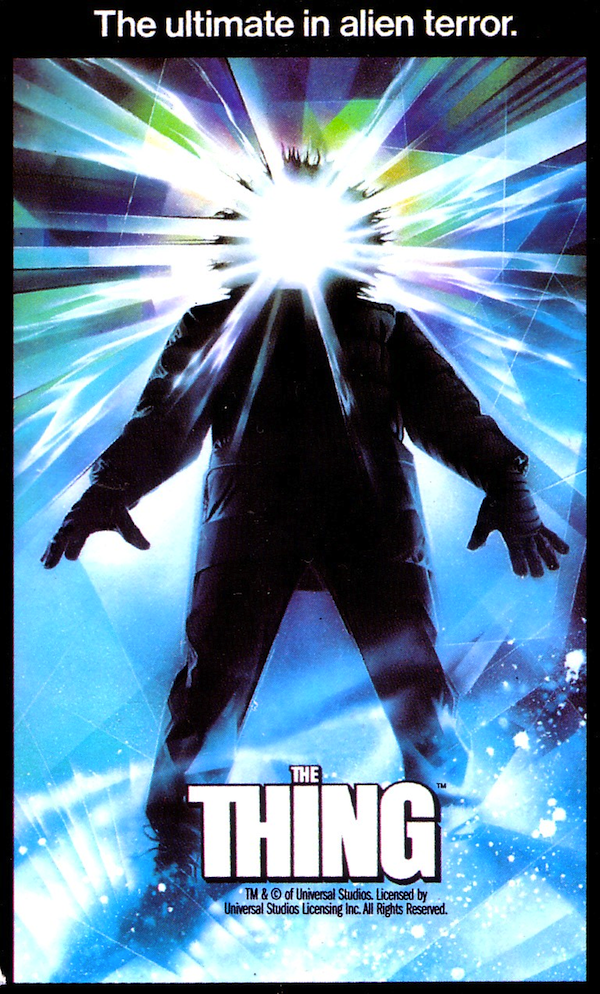
A few of my favorite movies are remakes, actually. I didn't quite realize it until I sat down to (finally) get this entry together, (Apologies for the big gap of radio silence, by the way, was getting over a cold and stuff, but I'm back and intend to stick to a daily schedule for a little while, then  make a schedule of Monday and Thursday updates) but my favorite horror movie is John Carpenter's The Thing.

And don't worry, fucker, I'm getting to you...
The Thing is basically a perfect horror film. I have talked about a few movies I consider perfect on this space, but this is one where I'll brook no argument. If you don't like it you are wrong, sorry.

And one of the reasons it's so good is that it doesn't make the original film that inspired it, the 50s classic The Thing From Another World by Howard Hawks, look worse, nor does it retread old ground. It explores places the first couldn't or wouldn't touch, and finds ways to reimagine the threat of the Thing for a whole new society, while also giving homage much more directly to the original inspiration for both films, the seminal sci-fi horror tale "Who Goes There?" by John W. Campbell.

I think  remakes can be awesome, and remakes are one of the ideas that often intrigue me personally. I'd love to try my hand at a few remakes myself. But I have a very strict criteria for if something needs to or should be re-made.


  •  Is there something about the original that hasn't aged well? (ie effects, performances, cultural context)
  • Does the idea have a new context or setting that could revive the material?
  • Is there room for improvement from an idea that maybe was cool initially, but not realized to it's full potential in the original? 

And that is where The Thing succeeds and the 2019 Pet Sematary falls flat.

Like the Thing, Pet Sematary is the second film adaptation from an original literary source, hence why I brought up this particular example. I know the first film also had a sequel, but that one wasn't based on anything by the original author and I'm not counting it for these purposes.

Two other favorites of mine come from the same well of horror movies from the 50s remade in the 80s, and I consider John Carpenter's The Thing, David Cronenberg's The Fly, and Chuck Russel's The Blob to be a damn near perfect triple feature if you're looking for a good time in quarantine...


When Posters
Kicked All
The Ass


The first revisited the source to bring to life a creature that would have been impossible in the 50s, The Fly crafted a whole new tale that took the same basic premise and turned it into a tragic love story that is a perfect allegory for terminal illness in a relationship, and The Blob just took something that was hokey in it's own time and made it into a practical effects gore-fest  that while not ground-breaking was just as fun as the original, but in very different ways.

So for the TL;DR crowd, good remakes elevate their source. Bad remakes loot the corpse of their source.

So let's dig in to Pet Sematary shall we?

II: Why Dead Is Better, or How To Take the Bite Out of a Horror Story

Did I mention that book covers used to be rad as hell too?
Cuz they were, once upon a time...

Pet Sematary started life as a novel the author didn't want to publish.

I think that is a really interesting indicator of how this is a story that goes deep into that darkness I love so much. STEPHEN KING  said "Yeeeaah, this is a little much..." and put it away. It was only published later because of contractual obligations, and I'm assuming with Steve looking at them like Jud Crandall like "Now, if ya read that book thayah, which ya SHOULDN'T..."

And you know, having read the book before anything else? I get it. This book is harsh. Even the kindest paragons in the story have darker sides to them, the evil in the story is pervasive, and the threat of death at best and true corruption at worst looms over literally every character no matter how innocent. And I fucking love it.

I see no reason to go easy on fictional characters when you're trying to make a point about the all-consuming power of grief and the corrupting power of "What if...?" made manifest in the Burial Grounds of the story. I had lived through the grief of losing a brother by the time I had read the book for the first time and the dark pull of the Pet Sematary resonated with me. I got the temptation that Louis Creed felt, that thought that "Yeah, I know the risks, but maybe this time... THIS time, it'll work...".

And what makes the story so heart-breaking is that there are very few points where things are actually good for our main characters. They are moving as a last ditch effort to keep their family together and make things better, forgetting that wherever you go, you take your baggage with you. So once things get good and weird, well you're seeing why they are this kind of desperate to fix something,  anything but more of this pain.

So, that is where we come to the meat of my problem with this movie. It starts by showing us the happy family driving in the car, the stock, lazy-as-hell way to introduce us to our cast in lots of horror movies. Some folks load in lots of little details in this and make me forgive them, since that is how things are in the book too. But in the book we are made privy to how awful this drive has been. Louis Creed, our hero, actually muses on both throwing the cat out of his car and peeling off while his family is taking a leak and going to Mexico or something. Not seriously, but that the thoughts cross his mind at all tell you a lot about where he's at. In the film they're actually pretty psyched, and bland about the whole thing. This continues for the whole first act. Moments that set tone and keep the Creeds on the back foot still happen, but not in the rapid fire succession they do in the original narrative, robbing them of impact.

Lou's daughter Ellie gets stung by a bee almost as soon as they arrive, Lou can't find the keys to the new house, his toddler son is crying, and his wife is pissed at him about just...stuff in general. The only ray of hope in this sequence in the book is the appearance of kindly old Mainer Jud Crandall, the best character in my opinion in any version of the story.

But the film just has the standard family in a horror movie moves into their new house sequence, it just feels so...flat. And there's no Jud in the scene. That a movie takes longer to introduce a character than a novel is just silly to me.

And that is where this movie really started to piss me off. For every new idea it has, it does five things that just take the teeth out of the narrative. Moving in? No problem. Relationship of the parents? Solid, they're just a little on edge from the move. Ellie? Unstung, until much later in the narrative. Boy, those truck jump-scares sure are loud though, huh? The film thinks that's enough foreshadowing for now.


"Look sweetie, I'm not trying to stress anybody out, it's not like we're in a horror movie..."
And the thing I like about this story is that every major scene has it's own special tone, occasionally making the novel feel almost episodic early on, but with each set-piece coming together to build the web around the Creeds until suddenly they can't escape. But the remake just takes every major dynamic and set-piece and just waters them down.

Louis losing his first patient on his first day at the clinic he's working at, practically before he's gotten his coat off, is now several days after he's started. The sequence with Victor Pascow's death and everything related to it is done so predictably I was counting off beats in my head, like watching a re-run instead of a movie.

WELP I'mma just head out...
And the harshest elements of the narrative are excised entirely for your comfort. For example:


  • The fraught marriage of the Creeds is reduced to a few existential talks about what happens after we die that have very little bite, a far cry from the opposed views of a medical man and a woman raised in a well-off religious household.
  • Louis and his in-laws relationship goes from a constant thorn in his marriage to a nod at one another at a funeral. (a funeral where, in the novel, they get into a drunken fist fight and knock over the casket) They don't even get lines. No mention of my favorite element of this subplot either: that his father-in-law tried to pay him to break off their engagement when he was in college.
  • Mentions of the previous uses of the Burial Ground and the foul deeds of those resurrected there are relegated to a few lines in a newspaper clipping. These are full flashbacks in both the book and previous film, and enrich the story because they illustrate the brain-washing power of the spirits that reside there.
  • Rachel Creed's aversion to death is still because of her relationship with her sister Zelda, who died slowly and horribly of spinal meningitis. But we are largely told this because showing too much might make someone uncomfortable, and we wouldn't want that. 
  • As usual, in every version of this story, Jud's wife Nora is cut loose almost entirely, her part of the story assigned to another character made up for the 80s film, and here just removed until a scene that I think was part of a mostly deleted subplot about Jud burying Nora in the Burial Grounds, but that is never hinted at before or after and feels tacked on.
  • And of course, the deaths in the story are mostly sanitized and the most important actually happens in a strangely bloodless off screen way that has a whiff of a re-edit. But we're about there.
So, any choice that has some interesting element, like the casting of John Lithgow's Jud as a much more morose character with a hole of grief in his heart and weary smile (and he strangely feels on autopilot here for the most part, bringing none of his usual energy or eccentricity to the part), the strangely ritualistic way local children bury their pets with an eerie procession with masks, or the new ways that Rachel Creed's sister Zelda factors into the narrative, are undone by making the film around them like a quieter, gentler version of the 80s adaptation.

 For a film with a lot of horror built off meningitis, this film severely lacks a spine.

Don't look sad John, this isn't your fault my dude.

III: Adaptation Decay, and Why Surprises Aren't the Same as Twists

Adaptation Decay is the process that naturally occurs when a story is moved from one format to another. Obviously, a movie based on every little detail of a book would be unfilmable, even for one as straight-forward as Pet Sematary, such a beast would probably be in the neighborhood of six hours.
So stuff get's trimmed, condensed, or excised. And the 2019 film has a major, terminal case of AD. I think, after comparing the finished product to the trailers, this movie went through some heavy edits and reworkings. The things I've mentioned that I found really interesting seem to be from a much more liberal and creative cut of this flick that I'd love to see, but I doubt that is forthcoming. If the Snyder Cut doesn't exist (and believe me, it doesn't) then the Interesting Cut of PS'19 is nowhere in sight, guys. So what I've got to work with is what's there, not what I think might have been there in another cut.

Which is where the point of my last section comes in. For those that came in late, and don't care about spoilers, the story of  Pet Sematary is pretty simple: Louis Creed and his family move to Maine, make friends, experience some minor deaths, then discover the quaint "pet sematary" is merely the gateway to much more sinister den of evil deep in the backwoods of Little God Swamp, an ancient corrupted burial ground dating back centuries that revives the dead, but brings them back...wrong. Louis is shown this when his daughters cat Church dies, and Jud shows him the way to use it's power. The cat returns, but is a stinking, dirty, predator that frightens his children and is generally a shit.

He doesn't want chicken, but he'll take your liver, if you got one...

 But once tapped into, the spirits there seem to ensure that you'll return one day, or show someone else the way to use them. And Louis is forced to consider it when his son Gage is killed in a horrific accident. If the forces in Little God are capable of making such things happen is toyed with, but never confirmed or denied. All we know is that the seductive evil will not stop until it's completely destroyed the Creeds.

And yet again, this is where the film falls apart. It was first hinted at, then out and out confirmed that the chief way the 2019 version would differ from the originals was that Ellie would die instead of Gage, a fumbled ball from the get go. The film is shot, edited, and presented as if this is supposed to be a surprise. And since it's not, I'm already tired of this being referred to as a 'twist'. The directors reasons are sound, they wanted to explore more of the dissonance of the resurrection process with a character we talked with more, and had more of a personality to lose in the revival process. And aspects of this do work. Zomb-Ellie is damned creepy, and the scene where she dances in a dirty tutu with no grace, coordination, or charm as she did earlier in the film is the only properly good part in the whole movie for me because it was paced and executed well, and I saw the potential of what this could have been.

But twists are not just surprises hidden in a narrative. Twists should be surprising, yes. But then when you look back through the narrative, you see the subtle clues that let your brain know this was coming, but because of the artistic misdirection required, you don't see how it was done till later.

Essentially, a good twist is like a magic trick, and a bad one is just someone jumping out and yelling "Boo! I was the killer!" without preamble or foreshadowing. And yeah, the switcheroo of Ellie for Gage is on that level for me, a choice that could have been artistically fun and subtle being rendered graceless and clumsy, much like the resurrected version of the character, by the lackluster choices surrounding it.

Which has the end result of this version playing
like an incredibly dark version of "Go the Fuck to Sleep"..

And instead of the rabbit hole of different choices we could make once this deviation has been made, and the kind of things that could have made this a worthwhile remake (exploring new territory previous versions couldn't or wouldn't go to), the back third of this movie is just a lackluster tread through references to the last version, tensionless action, and a discarding of the rules of how the ancient burial ground works, which leads to a pretty meh ending that thinks it's much more clever than it is.

And why was THIS never even mentioned again?

So, in the end all I can say is put this one at the back of your watchlist if you still feel like checking it out. But I feel it'd be better served by burying it far away and hoping against hope and sanity that it comes back better...

NEXT TIME: LIVE FROM NEW YORK, IT'S CANNIBALISTIC HUMANOID UNDERGROUND DWELLERS!!!